
























You are looking at the documentation of a prior release. To read the documentation of the latest release, please
visit here.
New to KubeVault? Please start here.
VaultServer
What is VaultServer
A VaultServer is a Kubernetes CustomResourceDefinition (CRD) which is used to deploy a HashiCorp Vault server on Kubernetes clusters in a Kubernetes native way.
When a VaultServer is created, the KubeVault operator will deploy a Vault server and create necessary Kubernetes resources required for the Vault server.
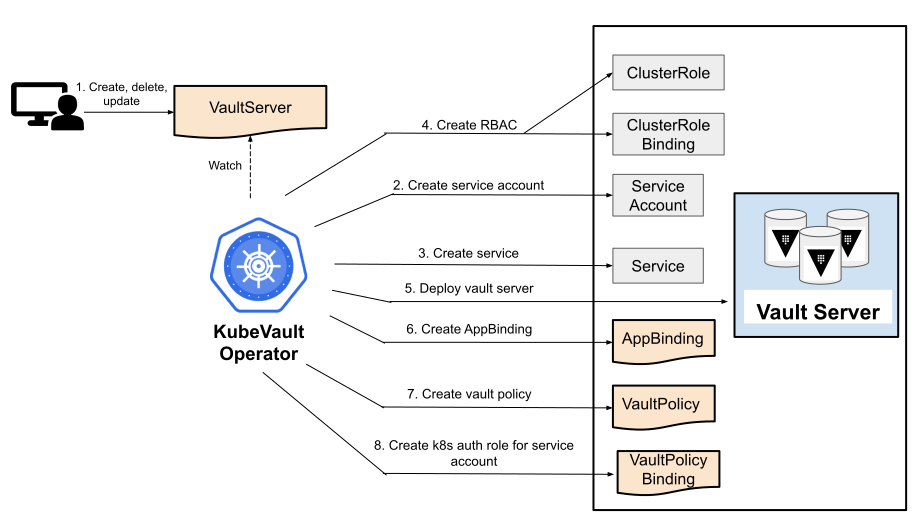
VaultServer CRD Specification
Like any official Kubernetes resource, a VaultServer object has TypeMeta, ObjectMeta, Spec and Status sections.
A sample VaultServer object is shown below:
apiVersion: kubevault.com/v1alpha2
kind: VaultServer
metadata:
  name: vault
  namespace: demo
spec:
  tls:
    issuerRef:
      apiGroup: "cert-manager.io"
      kind: Issuer
      name: vault-issuer
  allowedSecretEngines:
    namespaces:
      from: All
    secretEngines:
      - mysql
  version: 1.10.3
  replicas: 3
  backend:
    raft:
      storage:
        storageClassName: "standard"
        resources:
          requests:
            storage: 1Gi
  unsealer:
    secretShares: 5
    secretThreshold: 3
    mode:
      kubernetesSecret:
        secretName: vault-keys
  monitor:
    agent: prometheus.io
    prometheus:
      exporter:
        resources: {}
  terminationPolicy: DoNotTerminate
Here, we are going to describe the various sections of the VaultServer crd.
VaultServer Spec
VaultServer Spec contains the configuration about how to deploy Vault in the Kubernetes cluster. It also covers automate unsealing of Vault.
The spec section has following parts:
spec.replicas
spec.replicas specifies the number of Vault nodes to deploy. It has to be a positive number.
spec:
  replicas: 3 # 3 vault server will be deployed in Kubernetes cluster
spec.version
Specifies the name of the VaultServerVersion CRD. This CRD holds the image name and version of the Vault, Unsealer, and Exporter. To know more information about VaultServerVersion CRD see here.
spec:
  version: "1.10.3"
spec.tls
spec.tls is an optional field that specifies the TLS policy of Vault nodes. If this is not specified, the KubeVault operator will run in insecure mode.
spec:
  tls:
    issuerRef:
      apiGroup: "cert-manager.io"
      kind: Issuer
      name: vault-issuer
The server certificate must allow the following wildcard domains:
localhost*.<namespace>.pod<vaultServer-name>.<namespace>.svcThe server certificate must allow the following IP:
127.0.0.1
spec.configSecret
spec.configSecret is an optional field that allows the user to provide extra configuration for Vault. This field accepts a VolumeSource. You can use any Kubernetes supported volume source such as configMap, secret, azureDisk, etc.
Please note that the config file name must be
vault.hclto work.
spec:
  configSecret:
    <type of volume>: # for example `configSecret`
      name: <name of volume>
spec.dataSources
spec.dataSources is an optional field that allows the user to provide a list of VolumeSources (i.e. secrets, configmaps, etc.) which will be mounted into the VaultServer pods. These volumes will be mounted into /etc/vault/data/<name> directory. The first data will be named as data-0, the second one will be named as data-1 and so on.
spec:
  dataSources:
  - secret:  # mounted on /etc/vault/data/data-0
      secretName: custom-cert
  - configMap: # mounted on /etc/vault/data/data-1
      name: special-config
spec.monitor
spec.monitor is an optional field that is used to monitor the vaultserver instances.
monitor:
    agent: prometheus.io
    prometheus:
      exporter:
        resources: {}
spec.terminationPolicy
spec.terminationPolicy is an optional field that gives flexibility whether to nullify(reject) the delete operation of VaultServer crd or which resources KubeVault operator should keep or delete when you delete VaultServer crd. KubeVault provides following four termination policies:
- DoNotTerminate
- Halt
- Delete (Default)
- WipeOut
When, terminationPolicy is DoNotTerminate, KubeVault takes advantage of ValidationWebhook feature in Kubernetes 1.9.0 or later clusters to provide safety from accidental deletion of VaultServer. If admission webhook is enabled, KubeVault prevents users from deleting the VaultServer as long as the spec.terminationPolicy is set to DoNotTerminate.
spec.backend
spec.backend is a required field that specifies the Vault backend storage configuration. KubeVault operator generates storage configuration according to this spec.backend.
spec:
  backend:
    ...
List of supported backends:
spec.unsealer
spec.unsealer is an optional field that specifies Unsealer configuration. Unsealer handles automatic initializing and unsealing of Vault. See here for Unsealer documentation.
spec:
  unsealer:
    secretShares: <num_of_secret_shares>
    secretThresold: <num_of_secret_threshold>
    retryPeriodSeconds: <retry_period>
    overwriteExisting: <true/false>
    mode:
      ...
spec.serviceTemplates
You can also provide a list of templates for the services created by KubeVault operator for VaultServer through spec.serviceTemplates. This will allow you to set the type and other properties of the services. spec.serviceTemplates is an optional field.
Each entry is keyed by an alias that selects which Service it configures:
vault: the primary client-facing Service (<vault-name>), which selects all Vault nodes.internal: the headless governing Service used for per-pod DNS.stats: the metrics Service (only when monitoring is enabled).primary: the active-node-pinned Service (<vault-name>-primary), created only whenspec.exposePrimaryistrue(see below). Use this alias to, for example, expose the pinned Service as aLoadBalancerwhile thevaultService staysClusterIP.
spec:
  serviceTemplates:
    - alias: stats
      spec:
        type: ClusterIP
VaultServer allows following fields to be set in spec.serviceTemplates:
- metadata:
- annotations (set as annotations on Vault service)
- spec:
- type
- ports
- clusterIP
- externalIPs
- loadBalancerIP
- loadBalancerSourceRanges
- externalTrafficPolicy
- healthCheckNodePort
- sessionAffinityConfig
spec.exposePrimary
spec.exposePrimary is an optional boolean field that controls whether the operator exposes an additional client-facing Service pinned to the active (leader) Vault node. It defaults to false.
OpenBao unseals standby nodes read-only and lets them serve reads, so a client that writes and then immediately reads can be round-robined onto a standby that has not yet applied the write and see stale data. Most clients tolerate this, but some (CSI drivers, CI jobs, anything that treats Vault as a linearizable store) cannot. exposePrimary lets those clients read through the leader alone, where every write already lands, so read-after-write is guaranteed with no client changes.
false(default): only the<vault-name>Service exists, and it selects every Vault node. Behaviour is unchanged from earlier releases.true: in addition to the<vault-name>Service (which still selects all nodes), the operator creates a<vault-name>-primaryService whose selector narrows to the active node. A workload that needs strict read-after-write binds to<vault-name>-primary; everything else, including the default AppBinding, keeps using<vault-name>and is never affected. SettingexposePrimaryback tofalsedeletes the-primaryService.
The mechanism uses OpenBao’s native service_registration "kubernetes": each Vault process labels its own pod as active or standby, and the operator puts that label on the -primary Service selector. Because of this:
exposePrimaryrequires an HA-capable storage backend and a supported distribution (HashiCorp Vault or OpenBao). The admission webhook rejects it otherwise.- On an existing cluster the pin engages only after the pods are restarted (the StatefulSet uses the
OnDeleteupdate strategy), for example by a restartVaultOpsRequestor the next version upgrade. Until then the-primaryService keeps selecting all pods, so it never goes empty; the operator reportsClientTrafficPinned=Falsewith reasonNoActiveNodeLabelledwhile the pin has not engaged. - The
<vault-name>-primaryService has no endpoints during a leader election (for the brief window in which no node is active). This is the cost of the guarantee; a workload that cannot tolerate that window should use the<vault-name>Service instead.
spec:
  exposePrimary: true
spec.podTemplate
VaultServer allows providing a template for Vault pod through spec.podTemplate. KubeVault operator will pass the information provided in spec.podTemplate to the Deployment created for Vault. spec.podTemplate is an optional field.
spec:
  podTemplate:
    spec:
      resources:
        requests:
          memory: "64Mi"
          cpu: "250m"
        limits:
          memory: "128Mi"
          cpu: "500m"
VaultServer accepts the following fields to set in spec.podTemplate:
- metadata:
- annotations (set as annotations on Vault pods)
- controller:
- annotations (set as annotations on Vault statefulset)
- spec:
- resources
- imagePullSecrets
- nodeSelector
- affinity
- schedulerName
- tolerations
- priorityClassName
- priority
- securityContext
You can find the full list of fields here. Some of the fields of spec.podTemplate are described below:
spec.podTemplate.spec.imagePullSecret
spec.podTemplate.spec.imagePullSecrets is an optional field that points to secrets to be used for pulling docker images if you are using a private docker registry.
spec.podTemplate.spec.nodeSelector
spec.podTemplate.spec.nodeSelector is an optional field that specifies a map of key-value pairs. For the pod to be eligible to run on a node, the node must have each of the indicated key-value pairs as labels (it can have additional labels as well). To learn more, see here .
spec.podTemplate.spec.resources
spec.podTemplate.spec.resources is an optional field. This can be used to request compute resources required by Vault pods. To learn more, visit here.
spec.authMethods
spec.authMethods is an optional field that specifies the list of auth methods to enable in Vault.
spec:
  authMethods:
    - type: kubernetes
      path: k8s
    - type: aws
      path: aws
spec.authMethods has following fields:
spec.authMethods[].type
spec.authMethods[].type is a required field that specifies the name of the authentication method type.
spec.authMethods[].path
spec.authMethods[].path is a required field that specifies the path where to enable the auth method.
spec.authMethods[].description
spec.authMethods[].description is an optional field that specifies a human-friendly description of the auth method.
spec.authMethods[].pluginName
spec.authMethods[].pluginName is an optional field that specifies the name of the auth plugin to use based on the name in the plugin catalog.
spec.authMethods[].local
spec.authMethods[].local is an optional field that specifies if the auth method is local only. Local auth methods are not replicated nor (if a secondary) removed by replication.
spec.authMethods[].config
spec.authMethods[].config is an optional field that specifies configuration options for auth method.
spec.authMethods[].config has following fields:
defaultLeaseTTL:Optional. Specifies the default lease duration.maxLeaseTTL:Optional. Specifies the maximum lease duration.pluginName:Optional. Specifies the name of the plugin in the plugin catalog to use.auditNonHMACRequestKeys:Optional. Specifies the list of keys that will not be HMAC’d by audit devices in the request data object.auditNonHMACResponseKeys:Optional. Specifies the list of keys that will not be HMAC’d by audit devices in the response data object.listingVisibility:Optional. Specifies whether to show this is mount in the UI-specific listing endpoint.passthroughRequestHeaders:Optional. Specifies a list of headers to whitelist and pass from the request to the backend.
spec.relayPlacementRef
spec.relayPlacementRef is an optional field that points to an Open Cluster Management Placement object in the same namespace as the VaultServer. When set, the KubeVault operator deploys a VaultRelay to every managed cluster selected by the Placement, using one ManifestWork per cluster. This turns the VaultServer into the hub of a hub-spoke deployment: databases in the selected spoke clusters can be managed through this Vault without being reachable from the hub.
spec:
  relayPlacementRef:
    name: db-spokes
Requirements:
- The OCM hub CRDs (
Placement,PlacementDecision,ManifestWork) must be installed; the field is ignored with a warning condition otherwise. - Spoke clusters must be able to reach the hub Vault API (port 8200) and the spoke-relay gRPC proxy (port 50053) at an externally-resolvable address. By default the
vaultservice template must betype: LoadBalancer; alternatively, set thekubevault.com/server-addressannotation on the VaultServer to an external address (NodePort + external LB, Gateway, …) and the LoadBalancer requirement is waived. spec.tlsmust be enabled, since spokes connect over that external address.
For each selected cluster the operator creates a ServiceAccount (in the managed cluster’s namespace on the hub) whose token the spoke uses for kubernetes auth, a VaultPolicy and VaultPolicyBinding granting that ServiceAccount the permissions a spoke needs, a rotated bootstrap token for the bao relay join trust bootstrap, and a ManifestWork carrying the VaultRelay, its AppBinding, and the credential Secrets. See the hub-spoke deployment guide.
spec.relayTemplate
spec.relayTemplate is an optional field that customizes the VaultRelays stamped out for clusters selected by spec.relayPlacementRef. Per-cluster fields (spokeName, hubVaultRef, join material) are filled in by the operator.
spec:
  relayTemplate:
    namespace: demo                                  # namespace on the managed cluster (defaults to the VaultServer's namespace)
    image: ghcr.io/kubevault/spoke-relay:v0.1.0      # spoke-relay container image
    bootstrapTokenTTL: 24h                           # TTL and rotation period of bootstrap tokens (default 24h, minimum 1h)
    podTemplate: {}                                  # pod template for the spoke-relay pods
spec.isolateTenants
spec.isolateTenants is an optional boolean field, the master opt-in for tenant isolation, defaulting to false. When enabled on an OpenBao (namespace-capable) distribution, a SecretEngine whose database lives in a client-org Kubernetes namespace is automatically provisioned in an OpenBao namespace keyed on the org’s identity, and every dependent {db}Role / SecretAccessRequest inherits that namespace.
spec:
  isolateTenants: true
With the gate off (the default) everything stays in the root namespace, and an explicit SecretEngine.spec.namespace is rejected. The admission webhook rejects isolateTenants: true on a distribution that does not support namespaces (Vault OSS). Turning it on, or labelling a namespace later, never moves an already-mounted engine — see the tenant isolation guide’s migration section.
VaultServer Status
VaultServer Status shows the status of a Vault deployment. The status of the Vault is monitored and updated by the KubeVault operator.
status:
  phase: <phase>
phase: Indicates the phase Vault is currently in. Possible values ofstatus.phase:- Initializing
- Sealed
- Unsealing
- Critical
- NotReady
- Ready
authMethodStatus: Indicates the status of the auth methods specified inspec.authMethods. It has the following fields:type: Specifies the name of the authentication method typepath: Specifies the path in which the auth method is enabled.status: Specifies whether the auth method is enabled or not.reason: Specifies the reason why failed to enable the auth method.
relayPlacement: Summarizes spoke relay rollout whenspec.relayPlacementRefis set. It has the following fields:placement: The resolved Placement name.selected: The number of clusters currently listed in the PlacementDecisions.applied: The number of clusters whose ManifestWork has been applied.ready: The number of clusters whose VaultRelay reports phaseConnected.clusters: Per-cluster detail, each entry carryingclusterName,phase(the spoke VaultRelay phase, or hub-side valuesWorkApplied,WorkProgressing,WorkDegraded),tokenExpiry(when the current bootstrap token for that spoke expires), andcertExpiry(when the spoke’s mTLS client certificate expires, as observed by the hub’srelay/spokesendpoint; absent until the spoke connects).
status:
  relayPlacement:
    placement: db-spokes
    selected: 2
    applied: 2
    ready: 2
    clusters:
      - clusterName: cluster-1
        phase: Connected
        tokenExpiry: "2026-06-13T10:00:00Z"
        certExpiry: "2026-07-12T10:00:00Z"
      - clusterName: cluster-2
        phase: Connected
        tokenExpiry: "2026-06-13T10:00:00Z"
        certExpiry: "2026-07-12T10:00:00Z"
Hub-spoke deployments add the following condition types to
status.conditions:RelayPlacementResolved: the Placement exists and its PlacementDecisions were read.RelayHubInitialized: therelay/backend is mounted, the spoke-CA is initialized, and the advertised endpoint matches the LoadBalancer address.RelayManifestWorksApplied: every selected cluster has an applied ManifestWork.RelaysReady: every selected cluster’s VaultRelay reportsConnected.
Setting
spec.isolateTenantsadds the following condition types tostatus.conditions:TenantIsolationReady: the gate is on and the backend supports namespaces.TenantIsolationUnsupported: the gate is on but the backend has no namespace support, so isolation stays inert and SecretEngines resolve to root.